
A quick look at Banjo Pegs
The earliest banjos were gut strung instruments and had simple pegs for tuning the strings:
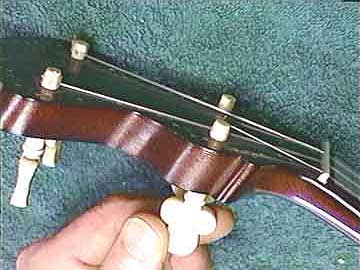
These tapered friction devices worked quite well for the low tension and stretchy nature of gut strings.
Long about 1900, "patent pegs" were the standard:
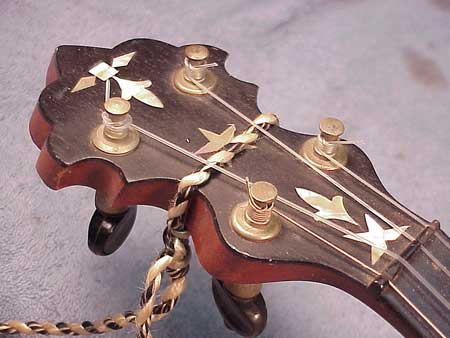
This old Stewart has Grover Champion pegs.
They work even better than the tapered pegs, and rely on the friction between the metal parts and the wood of the banjo peghead:
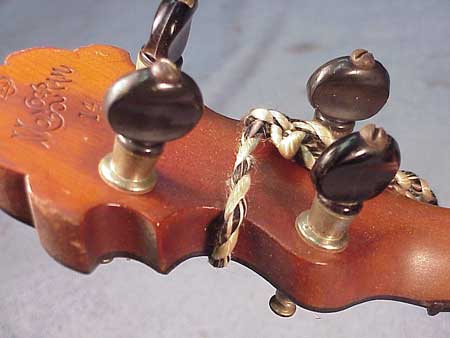
Tightening the central screw in the button increases the tension.
With the advent of steel stringing, geared pegs became available for the higher priced instruments. This modern banjo is a replica of a vintage Vega instrument, and is fitted with the best modern geared banjo pegs:
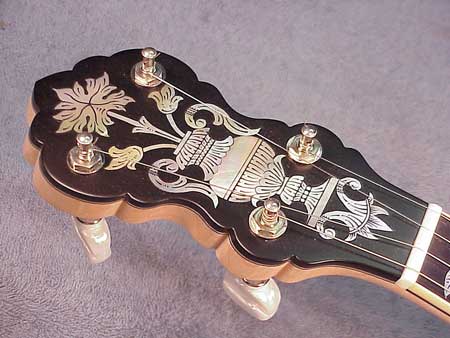
From the back, you can see that they are made in the general pattern of the old friction pegs, with the tuning knobs sticking straight back:
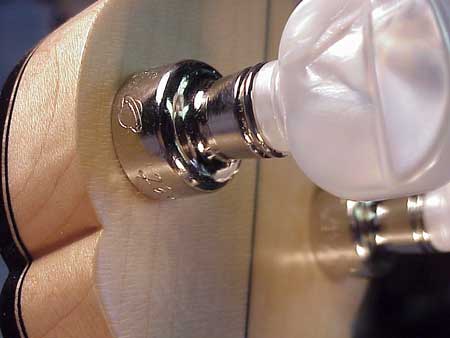
Because banjo tuners hold so closely to the look of the old time friction pegs, we still call them "pegs," "tuning pegs," or "geared pegs," rather than "tuning machines," "tuners," or "gears," as we would if we were referring to the hardware on a mandolin or guitar.
By the way, here is the finest of the old 1920s geared pegs, after which the ones above were fashioned:
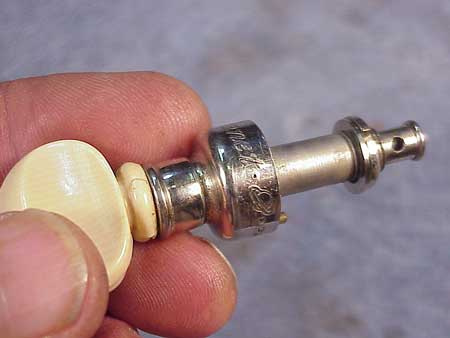
It's the famous "Planet" peg. A 4:1 planetary gear drive is enclosed in its tidy housing. To this day, no better, smaller or more elegant mechanism has been designed as a standard banjo tuner.
I cut apart one of the new replicas, so you could see the planetary gears inside:
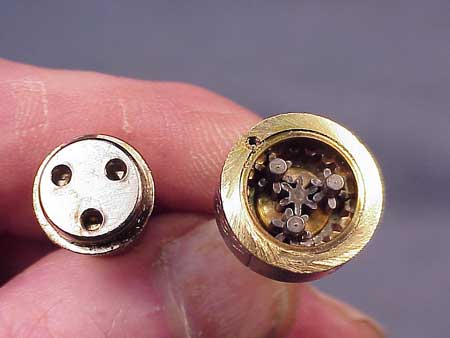
These pegs are currently made by Stewart-MacDonald, and are every bit as good as the originals. Take a look at those tiny 6-tooth planet and sun gears. They're machined of stainless steel, and run inside the brass ring gear. The three-holed plate connects to the tuning barrel, and rotates as the planet gears make their way at a 4:1 ratio around the ring gear.
Most other geared banjo pegs are somewhat clunky looking in comparison, and generally not as complex inside:
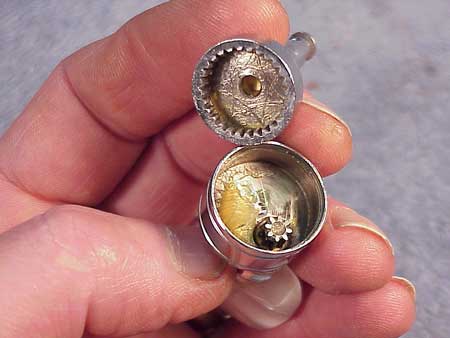
This 4:1 peg as a simple cog off center which drives a ring gear.
Here it is from the outside:
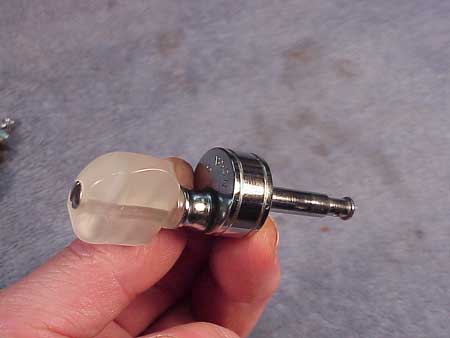
Notice how far off center the button shaft is. That's typical of lesser quality pegs.
This old Grover has a 2:1 gear ratio, and is almost as cranky as a friction peg:
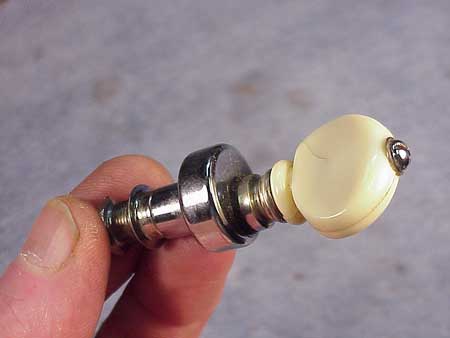
These Korean banjo pegs are not only ungainly, but rough, and rather prone to breaking:
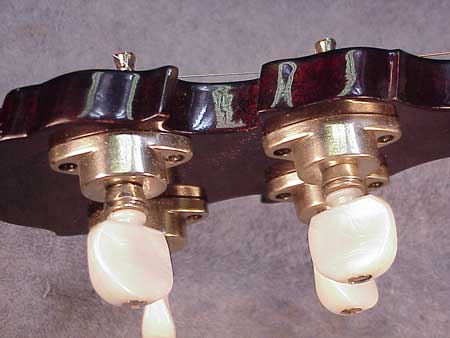
That's a real problem with inexpensive banjos. In order to pay homage to tradition and cut corners at the same time, the workability of the tuning pegs often suffers.
The maker of this inexpensive banjo skates the issue altogether, simply using inexpensive 12:1 ratio open guitar tuners:
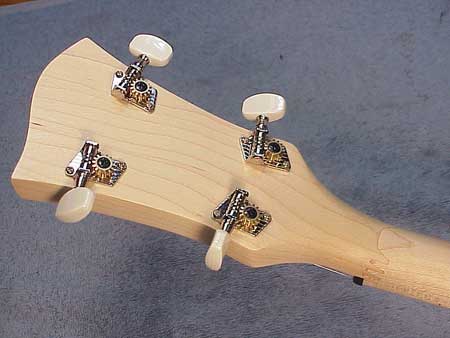
Personally, I like this option better. It allows for very good tuning, and skips the old time artful design. After all, it's the beginner who needs the most help tuning!
The last development in the five string banjo was the elimination of this nasty bit of hardware:
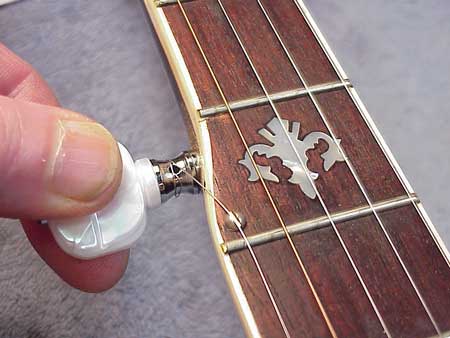
Long after friction pegs became obsolete, five string players had to contend with the imprecise, sticking, slipping friction fifth string peg. Friction fifth pegs are still common on inexpensive banjos.
Now, though, we have a fine alternative, a geared right angle drive peg for the fifth string:
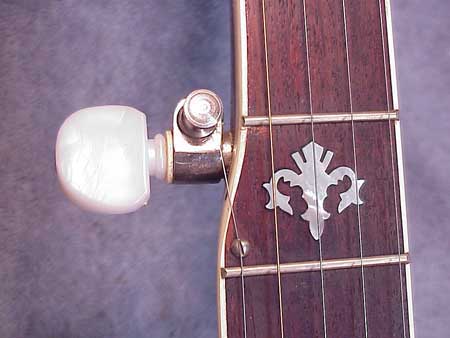
Installing one of these geared pegs is the kindest thing we can do for a beginning five string player!