
Rare Earth Magnets
Clamping, locating, sanding
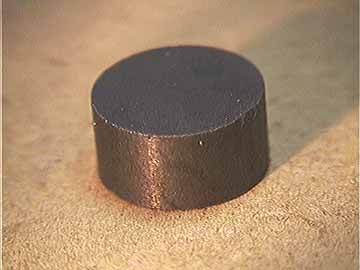
This is a close-up of the strongest magnet around. It's a mysterious alloy called "Neodymium" and it's a half inch in diameter and a quarter inch thick:
An innocent looking little fellow, but he's tough!
I get these from Dowling Magnets (on my sources list) and find them extremely useful. It seems that a couple of years ago everybody I knew discovered these magnets independently at the same time!
I was playing around with electromagnetic clamping ideas, stumbled onto the rare earth magnets, dropped the electric ones, and haven't looked back since.
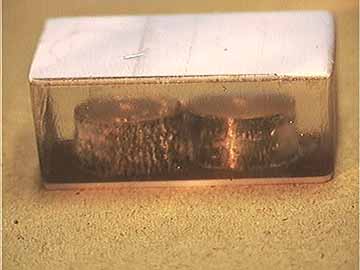
I drilled some 1/2" acrylic 1/4" deep with my Forstner bit and glued in two magnets, with opposite poles up:
The white surfaces on both sides of the acrylic blocks are 1/32" thick Teflon that I glued on to prevent the blocks from sticking to glue, etc.
Before you ask, the answer is yes, you CAN glue Teflon. You can get this thin Teflon from M.S.C. which is chemically treated on one side so you can glue it with ordinary epoxy. It doesn't bond perfectly, but it holds just fine for this kind of service.
Here's my favorite use for the magnet blocks.
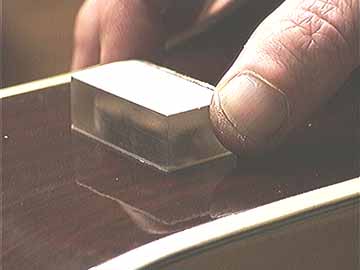
When I need to add a side reinforcement brace to a guitar, I place a block on the outside of the side and align it so the edge is right over the area where I want my brace to land:
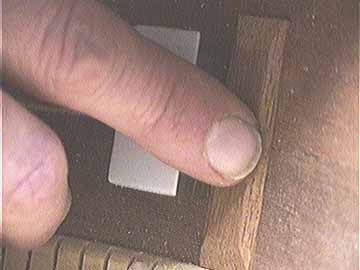
I drop a mating block inside, and because there are two magnets with opposite polarity, the inside block aligns itself directly under the outside one. Then I get my brace ready to glue, and I reach inside and place it exactly where I want it to go, right next to the magnet block, using the side of the block as a guide:
This has to be the slickest way to get that brace lined up vertically and in the right place while working "blind" with your arm in the soundhole!
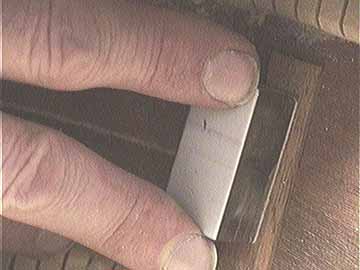
Then, I can slide the outside magnet and lift the inside one right on top of the brace to act as a clamp:
So I got excited and called Dan Erlewine and told him of my new technique. He said, "Yeah, I've tried that and it works great. Now let me tell you how I've been using magnets. . ."
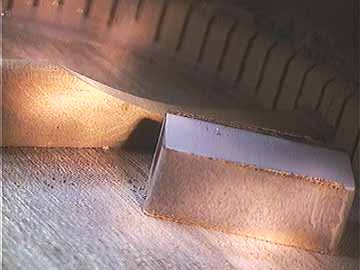
Here's that trick I learned from Dan.
Just wrap the magnet in sandpaper:
Lay some protective tape on the outside of the guitar to protect the finish, then all you have to do is scrub back and forth with the magnet on the outside to do a quick and perfect job of sanding the most inaccessible interior surface.
That was a hot tip, Dan.
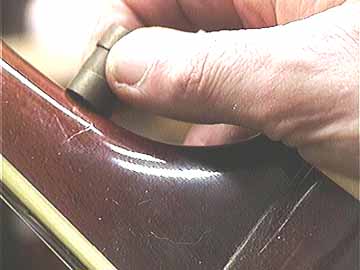
Here's another.
I keep some spare loose magnets around just to locate steel inside instruments. Here I'm able to sense the steel reinforcement inside a mandolin neck:
Regular magnets aren't always strong enough to do that.
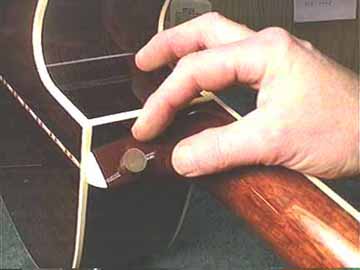
And here, I can find the exact location of a hidden neck attachment bolt so I don't get a big fat surprise when I drill for a strap button: