
Acoustic Guitar Tone Woods
What wood you like?
I'd like to say a few words about tone woods for acoustic guitars. My aim here is to present a quick, cursory look at the woods used for guitar bodies, and to talk a little about their performance. Please understand that this little article is just a simple primer for folks who'd like a quick overview of the materials used in guitar making.
Let's take it from the top.
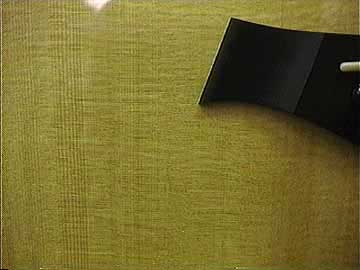
Acoustic guitar tops are most commonly made of spruce:
Spruce is number one on the list of strength-to-weight ratio for all the woods in the world.
So, for a given strength, a piece of spruce will weigh less. That's why it has been used in aircraft, ship masts, and a variety of other structural situations. A guitar top is a structural situation to be sure. The relentless pull of the strings demands that the top of the guitar be very strong; the need for good resonance demands that the top be as light as possible.
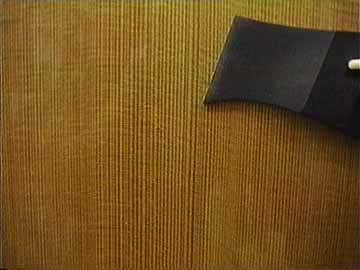
The next wood on that same list is cedar:
Not by coincidence, cedar is the second most popular top wood. Cedar looks a lot like redwood: darker and reddish compared to spruce.
So, what do you get with each? In a general sense, I think you get slightly crisper highs and a bit more power from spruce, and a little more mellow sound from cedar. It gets tricky describing subtleties of tone, and I'll try not to get into too much of that because there are so many variables.
There are lots of varieties of spruce, and each top will have differences in grain pattern, stiffness, density, etc. That means my generalizations are just that. In all cases it's best to hear the instrument and decide what you like! Any number of instruments seem to break the rules.
Here's a generalization based on our observations at Gryphon, where we see lots of new instruments from large manufacturers where top thickness and other factors are very consistent:
IF ALL OTHER THINGS ARE EQUAL, that is, if we're talking about guitars of the same model, size and detail of construction, by the same maker, with the same neck angle, bridge height, top thickness, species of top wood, age, then it appears:
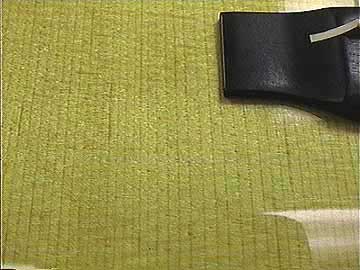
A wide grain top will tend to produce stronger bass response:
That's because there are fewer stiff grain lines so the top is more flexible. From the flexibility comes a lower natural resonant frequency and more easily produced bass notes.
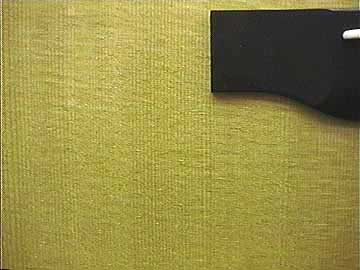
A narrow grain top will have comparatively stronger treble and more subtle bass:
This top has lots of hard grain lines, is much stronger and has a higher natural vibrating frequency.
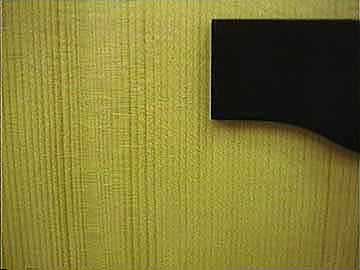
Here's a medium grain top:
Yes, it will tend to have a tonal response that's intermediate as well. Notice also that this particular top has "stripes" of dark and light grain lines. Most of us agree that color uniformity has no real bearing on the "quality" of the top wood. Just a matter of appearance and personal taste.
What should you look for? Take your pick. Play lots of instruments and judge the tone you like for yourself. Bear in mind that business of "all things being equal." If you're going to try to predict the tone based on appearance you'd better be talking about the same model made by the same manufacturer.
Individual luthiers, by the way, commonly take into account the stiffness of a top and may use different thickness and or bracing for tops of different stiffness. It's usually best to let the individual builder do his own thing. As a player, you can just request tone, but it's not a good idea to try to tell the builder how to achieve that!
Various species of spruce have been used for steel string guitar tops over the years, and each have their devotees. I'm not going to get into speculating about predicting the sound of individual species, partly because of the extreme difficulty in making a positive identification.
Time for an anecdote:
I attended the A.S.I.A. Symposium in 1995 and saw a number of vendors selling guitar tops in the exhibition hall. At dinner that evening I sat at a large table with Tom Humphrey, the well known classical guitar builder. Tom was talking to one of the spruce suppliers and describing how he had selected the Adirondack spruce (also known as red spruce) tops he'd bought earlier.
I asked the vendor about his spruce, "Do you know why it's called 'red' and how can you distinguish it from other spruce." He told me," I really don't know. I can't tell it apart from other species. I just have to take the word of the man who brings me the logs. He says it's red spruce."
Certainly there are general characteristics of color and grain that help in identifying species, but these characteristics overlap to such an extent that I really wonder if it's possible to make a positive identification of all samples.
Whatever the species they use most luthiers try to find top wood with as little grain runout as possible.
Other coniferous (softwood) species are sometimes used for guitar tops. We've seen a number of redwood tops, and a few larch, fir and pine.
Some guitars are made with hardwood tops, such as mahogany. I've found that hardwood tops tend to have less response at both ends of the spectrum, producing a guitar with a very strong emphasis on midrange. Hawaiian steel guitars are almost always made with koa or mahogany tops to give them their characteristic sweet, "mellow" sound.
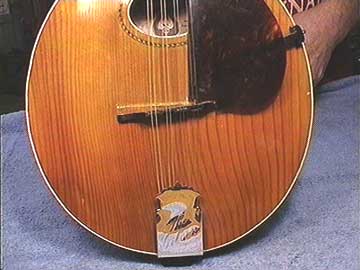
Before you go to hardwoods for backs and sides, take a look at this one:
It's a ninety year old Gibson mandolin with just about the most uneven looking spruce grain I've ever seen in a good instrument's top. The two halves aren't matched at all (not unusual for early Gibson mandolins, by the way) and the treble side has the widest grain imaginable. And, wouldn't you know it, this instrument is exceptionally good sounding, and there is not the least sign of structural failure in the top!
The backs and sides of virtually all guitars are made of hardwood. Strange as it may seem, softwoods just don't bend well and are more difficult to form into guitar sides. And there is the matter of tone, too.
Sides just don't enter into the vibrations nearly as much as tops and backs. They define the body shape and support the top and back. The back, however, is very significant. If you don't believe me, just sit and play a full chord with the back held tightly against your stomach, and then with the back held completely away from your body. Hear the difference in the fullness of tone?
Mahogany is the most commonly used hardwood for guitar backs because it's relatively economical, durable, attractive, easy to work and resonant.
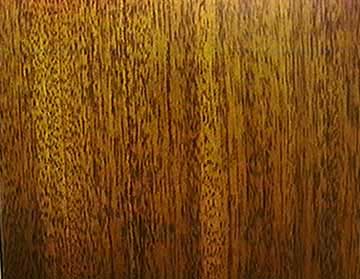
Mahogany is customarily stained:
Brown like this, or
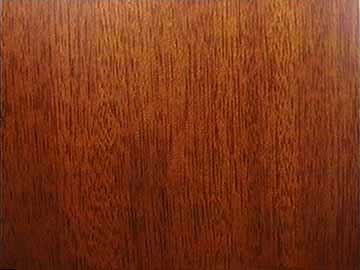
Reddish, like this

or left "natural" like this:
Time for a quick disclaimer: I realize that color resolution is not consistent on the Internet, so I'll just assume you can see the difference, but I'll use a few words to describe the colors along the way. Color is only one of the many criteria used to identify woods, so it's best to ask someone with more experience, if you're in doubt about a particular instrument's materials.
Mahogany is just about the lightest weight and least dense of all the hardwoods. A guitar with a mahogany back will tend to be very bright in its treble response, and correspondingly lighter in bass. Greater bass response comes from more dense woods.
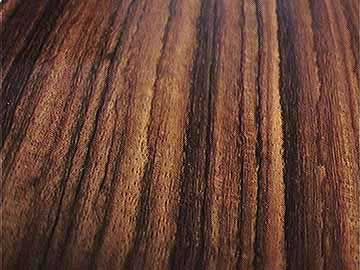
Rosewood is one of the most dense, heavy woods:
Many samples of rosewood sink in water, even when dry. The biggest bass response comes from guitars with rosewood backs.
Here's another opinion and a generalization: The darker the rosewood, the denser it is, and the more it will tend to emphasize bass.
Different species of rosewood have different densities as well, but there is a tremendous overlap of characteristics. The two main types of rosewood used for guitar building are Indian rosewood and Brazilian rosewood.
Besides being very beautiful and absurdly scarce, Brazilian rosewood has a reputation for sounding better. I think that guitars made of good dense Indian rosewood frequently sound stronger and better than their Brazilian counterparts, particularly if the Brazilian rosewood is less dense.
Remember, these generalizations only make sense when comparing identical instruments: same size, same maker, same bracing, same top and back thickness, same everything.
Most hardwoods fall somewhere between rosewood and mahogany both in density and predictable tone. Some commonly used woods that just about split the difference are maple, koa and walnut.
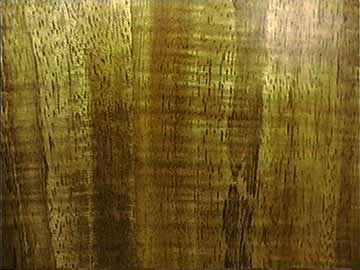
Hawaiian koa is a fantastically attractive wood:
Great variety of color and grain!
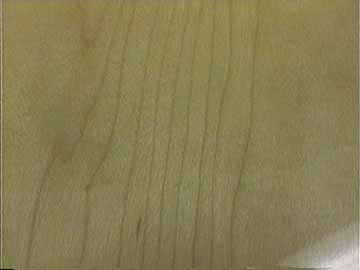
Maple can be plain, like this:
Or fancy, with curls and ripples in the grain, or even "birdseye" pattern. We generally accept that the "figure" or grain pattern of hardwoods has no influence on tone. Plain maple can make just as fine sounding a guitar as fancy maple.
Maple is very light in color and accepts stains beautifully, so it is frequently seen colored, or shaded as a "sunburst" pattern.